New insights into Eriosoma lanigerum (Hausm.), the Woolly Apple Aphid (WAA), through adaption of spring migration research methods
Abstract
Current survey methods for monitoring Eriosoma lanigerum Hausmann, the woolly apple aphid (WAA), in apple orchards are often labor-intensive, imprecise, and inadequate for addressing specific monitoring challenges. To improve this, we initiated the development of innovative approaches to investigate the spring migration and to monitor the colonization of individual observational trees. This study presents the preliminary findings from field trials conducted in 2021 and 2022. We evaluated the effectiveness of repeated, simplified surveys of easily observable parameters (e.g. WAA visual spring colonizzation % on shoots) on selected tree groups. When combined with additional field observations, these simplified methods enabled risk assessments of WAA infestation distribution at group or plot level, and offered a potential for near-term orchard-wide infestation predictions. Notably, a reduced, non-destructive shoot monitoring protocol on a limited number of observational trees yielded sufficient information on colony dynamics across larger orchard sections for the early spring period. However, attempts to extrapolate from current migration intensity to future shoot infestation levels proved unsuccessful. Surprisingly, we documented previously unreported migratory behavior in WAA instars believed to be non-migratory. Despite this, our initial results are promising and support the feasibility of simplifying WAA monitoring methods without compromising accuracy. Some findings, however, warrant further validation.DOI:
https://doi.org/10.23796/LJ/2025.006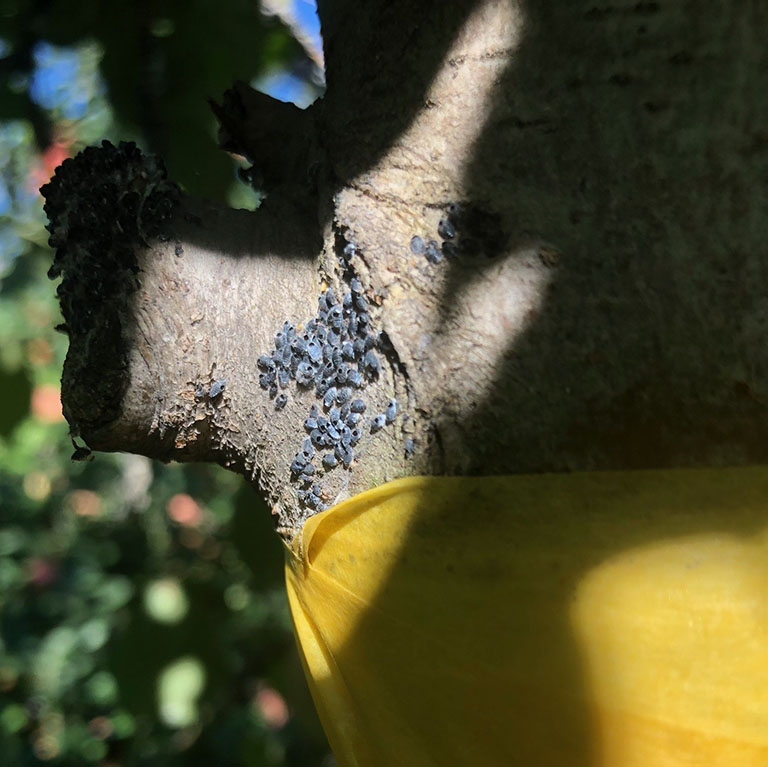
Published
03.11.2025
How to Cite
Wolf, M., Bortolini, S., & Gruber, A. (2025). New insights into Eriosoma lanigerum (Hausm.), the Woolly Apple Aphid (WAA), through adaption of spring migration research methods. Laimburg Journal, 7. https://doi.org/10.23796/LJ/2025.006
Issue
Section
Papers