Exploring the potential of FylloClip sensors for the detection of water stress: case studies on apple and grapevine
Abstract
Optimised plant water status is crucial for maintaining optimal yield and quality in horticultural systems, and yet its continuous, cost-effective monitoring on a large scale remains challenging. This study investigates the performance of newly developed capacitive leaf sensors, named FylloClip, for continuous water status monitoring in a range of application scenarios. Tests were performed on potted apple trees in a controlled climate chamber and in the open field, both in an apple orchard and in a vineyard. The sensors consistently demonstrated a clear response to variations in soil water availability, with daily capacitance peaks aligning with solar radiation cycles under well-watered conditions. In contrast, under incipient or advanced water stress, sensor capacitance responses were delayed, attenuated, or absent. Sensor orientation influenced recovery dynamics: east-facing sensors returned to baseline more rapidly after direct irradiation ceased than west-facing sensors, which often failed to reach baseline fully before the next daily peak. Seasonal trends were also evident, with nocturnal baseline values progressively increasing from summer to autumn, likely as a reflection of shifts in the balance between vapour condensation and moisture evaporation at the sensor/leaf interface. Given their affordability and operational simplicity, FylloClip sensors are promising in terms of their potential for precision irrigation management in perennial fruit crops.DOI:
https://doi.org/10.23796/LJ/2026.007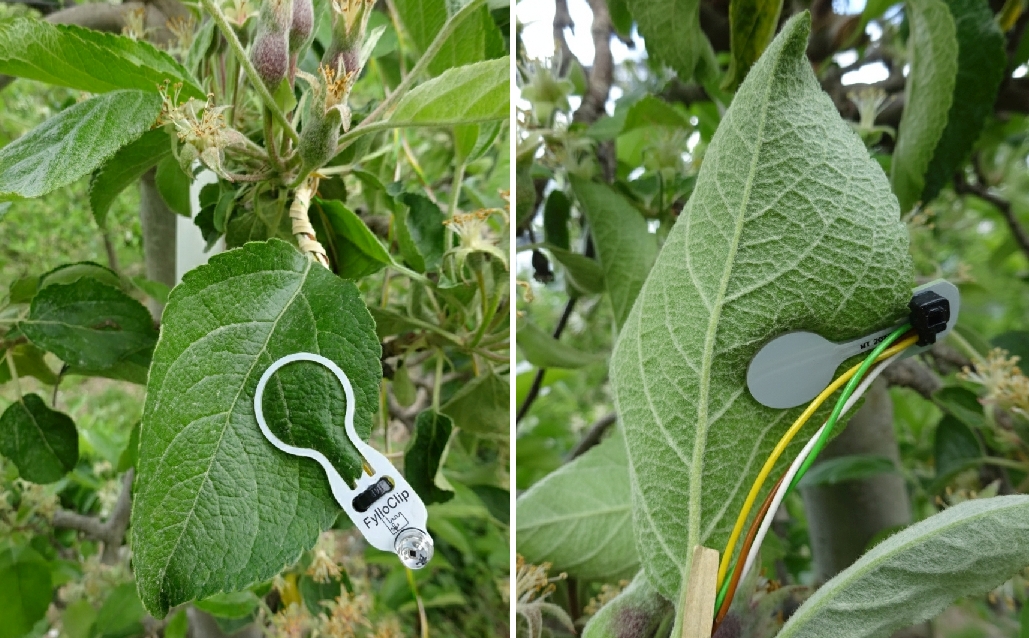
Published
03.07.2026
How to Cite
Thalheimer, M., Reim, S., Panzeri, F., Krug, S., & Guerra, W. (2026). Exploring the potential of FylloClip sensors for the detection of water stress: case studies on apple and grapevine. Laimburg Journal, 8. https://doi.org/10.23796/LJ/2026.007
Issue
Section
Papers