20 years of extensiv green roof research
Abstract
Over a 20-year research period, the Laimburg Research Centre in South Tyrol examined the ecological performance, hydrological efficiency, and biodiversity potential of extensive green roofs under sub-Mediterranean climatic conditions. The study evaluated twelve different green roof systems across three experimental phases (2005-2024), focusing on water retention, vegetation development, maintenance costs, and compliance with the Italian green roof standard UNI 11235 (2007, revised 2015). Results indicated annual water retention rates between 55.6% and 72.4%, with maintenance costs ranging from 0.3 to 85 €/m² per year. None of the systems initially met the UNI 11235 requirements due to challenges related to substrate properties and vegetation coverage. Increasing substrate depth and structural diversity improved both vegetation establishment and ecological functions. Substrates of 14 cm supported higher spontaneous species colonization compared to 8 cm, while depths of 20 cm allowed the integration of drought-tolerant shrubs, enhancing evapotranspiration. Later phases of research, habitat structures such as mounds, deadwood, sandy areas and stone walls were introduced, promoting biodiversity and the typical fauna of dry grasslands such as grasshoppers and butterflies.DOI:
https://doi.org/10.23796/LJ/2026.003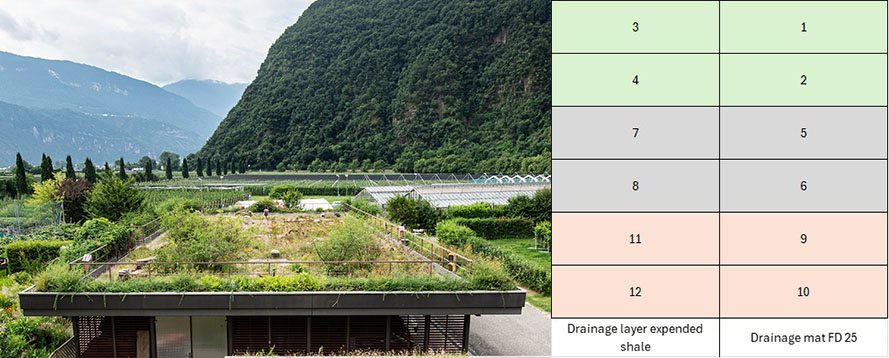
Published
31.03.2026
How to Cite
Salchegger, H., Kompatscher, P., & Hilpold, A. (2026). 20 years of extensiv green roof research. Laimburg Journal, 8. https://doi.org/10.23796/LJ/2026.003
Issue
Section
Papers